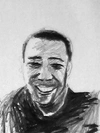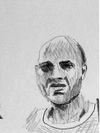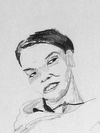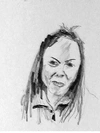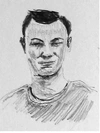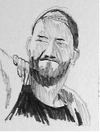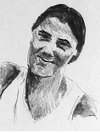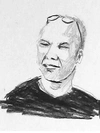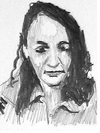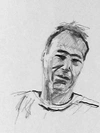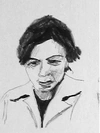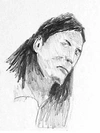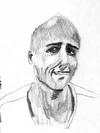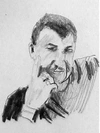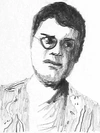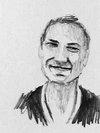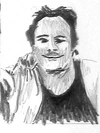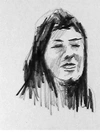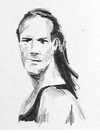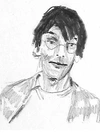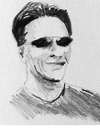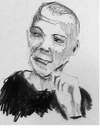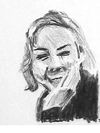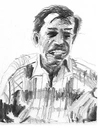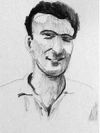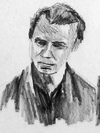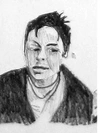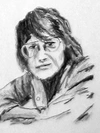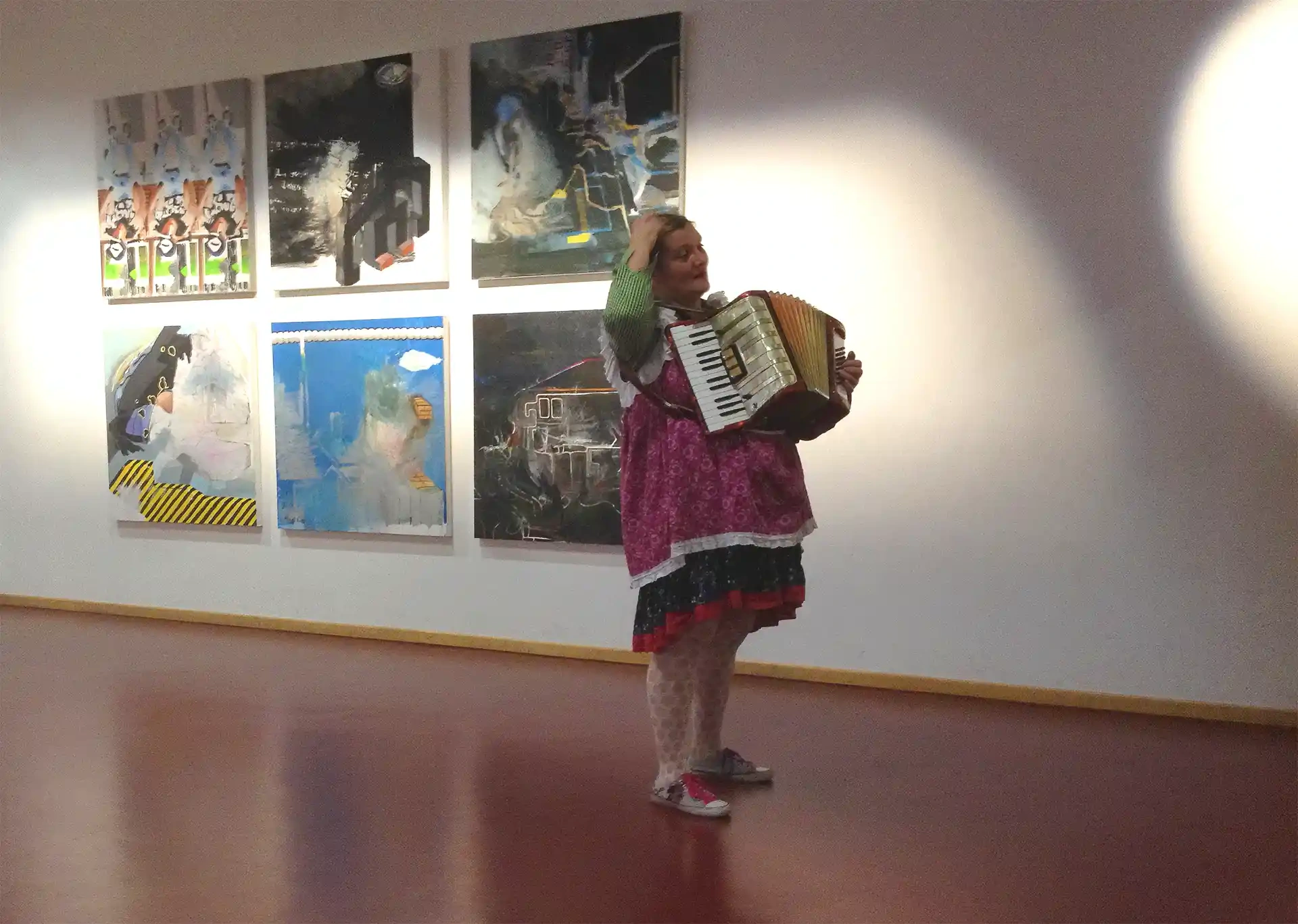
6 paintings by Martin Feldbauer during an exhibition at the Adlerwerke in Frankfurt

Martin Feldbauer

"Mücken am Rücken"

For my exhibition at the Adlerwerke, I explored the history of this place and asked myself how responsibility, systems thinking, malice, and stupidity are connected. The twentieth century has taught us that stupidity is not the opposite of intelligence. Alain Finkielkraut speaks of the “stupidity of intelligence”; for Dietrich Bonhoeffer, stupidity is not merely a lack of intelligence or education, but a human, moral, and sociological defect. Elias Canetti and Hannah Arendt reveal that evil and stupidity are not simply a lack of intelligence.

High cognitive abilities do not protect against misjudgments. People who think in terms of systems block out realities, leading to a loss of autonomy: Under the influence of power or ideologies, we abandon our own judgment and follow slogans. Facts that do not fit into our own worldview are ignored. This form of stupidity is more dangerous than pure malice because it often justifies itself rationally or morally and considers itself clever. Therefore: In everything that happens to a person, the person also has a hand in it. We are not merely pawns and products of structures.

Hafenbad Visitors

Portrait, pencil on paper, drawing by Martin Feldbauer (thanks to Jan Posth), Hafenbad 1996

Hafenbad is a project by Daniel Milohnić and Dirk Paschke. Built by hand on a minimal budget, a swimming pool was installed between the harbor basin and the silos using two shipping containers. The pool was simply fantastic, and many visitors kept coming back all summer long.


Hafenbad Photo: Martin Feldbauer

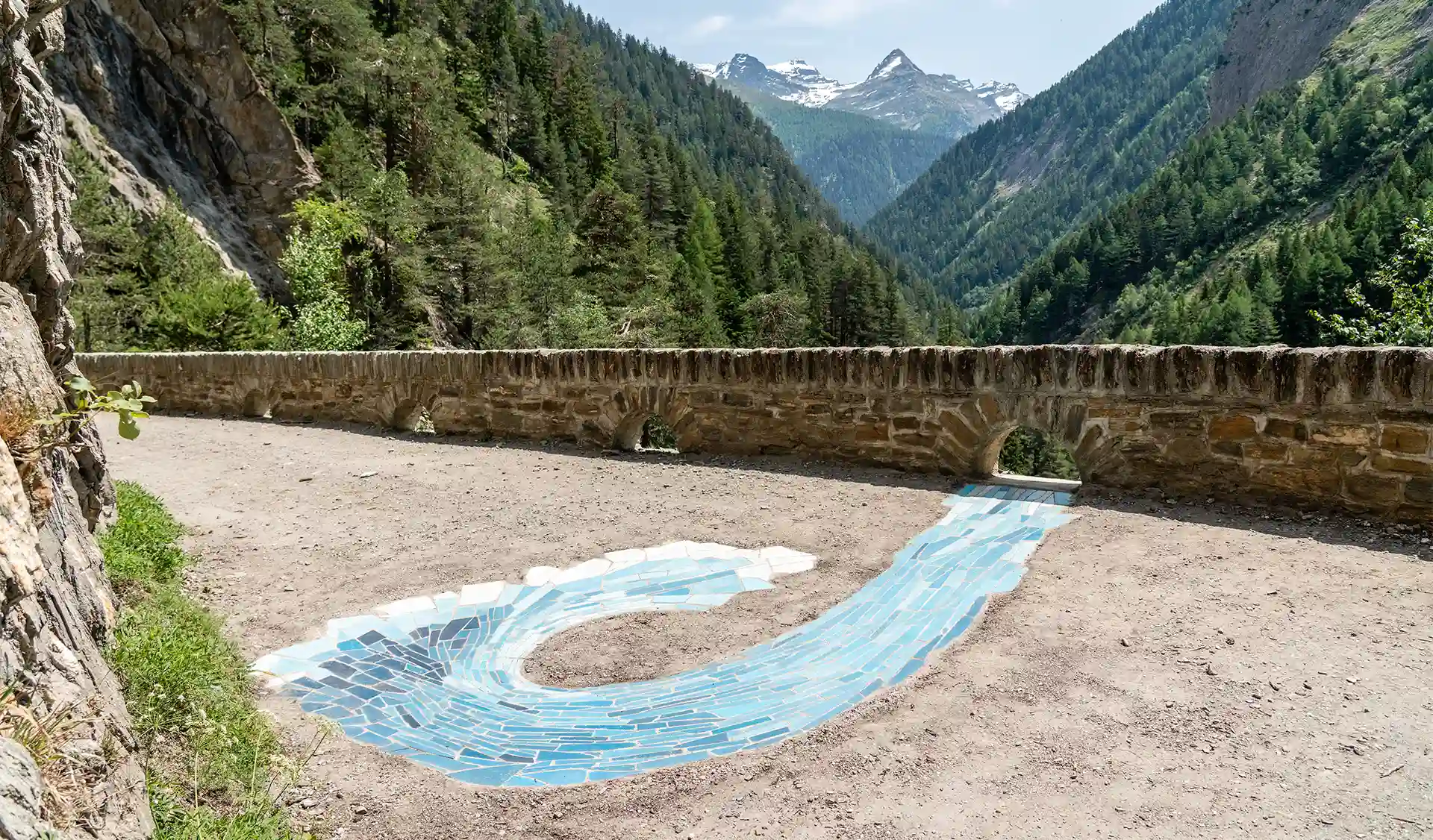
A Mosaic in the Swiss Alps by Anne Lina Billinger and Martin Feldbauer. Foto copyright: Matthias Luggen

Be water my friend

A project with Anne Lina Billinger

Our material list:

Garden hose

Reinforcing mesh

Casting gun

Plastering tub

Pattex

Natural Stone Chippings

Wheelbarrow x2

Blue 50l barrel

Black 30l barrel

White 20l canister

Black round and rectangular buckets

Buckets x5

Gloves x4

Barrier tape

Tile nippers

Tile cutter

Rubber mallet x2

Hammer

Ground anchors

Assorted acrylic paints

Assorted brushes

Tarpaulin

Measuring cup

Safety glasses

Sponges

Spirit level

Garden shovel

Spade

Rake

Hoe x2

Putty knife

Trowel

Cordless drill x2

Drill bits x2

Watering can

Smoothing board x4

Joint float x2

Pressure sprayer

Wallpaper brush

Parasol

30kg self-leveling screed x7

Lime

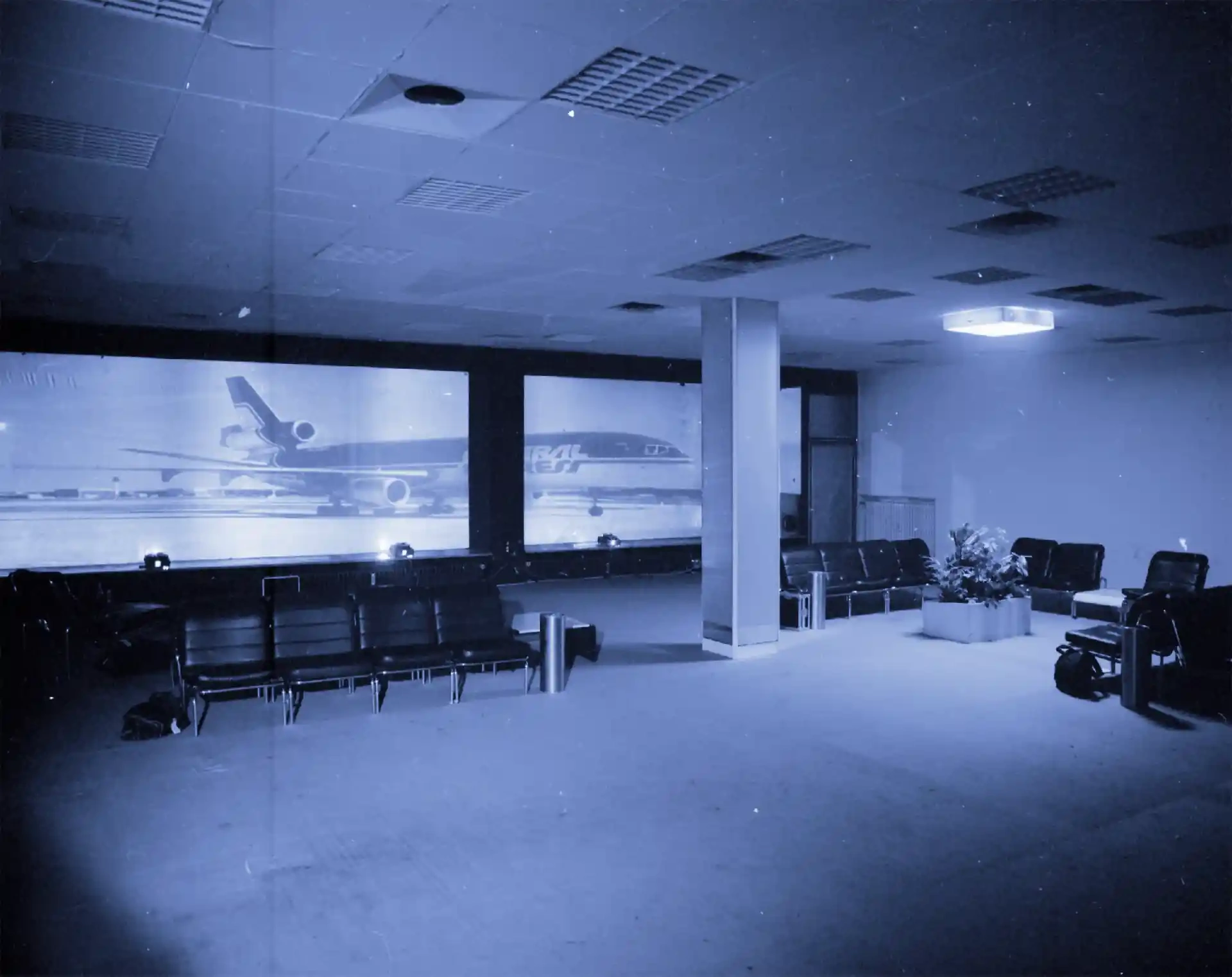
Installation of an airport waiting lounge at the Phantombüro in Frankfurt, 1998

Threshold

Installation of an airport waiting lounge with Dirk Paschke
at the ♣ Phantombüro

Paintings from Martin Feldbauer

"Opium Den" and "Spurensicherung"
280 x 280 cm each, painting, acrylic on linen
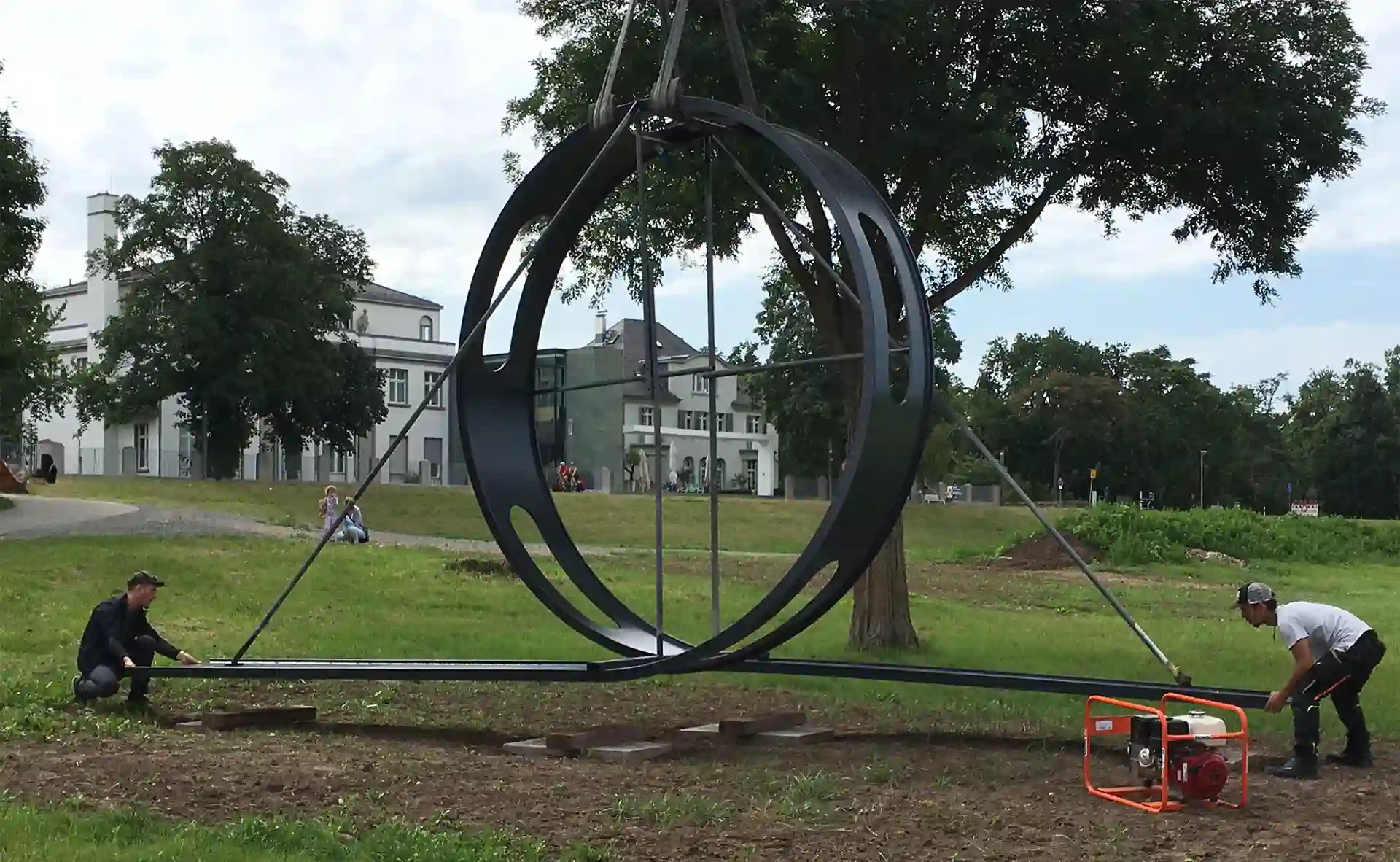
A steel sculpture by Martin Feldbauer in Rüsselsheim

Shortcut

A loop along the banks of the Main river in Rüsselsheim
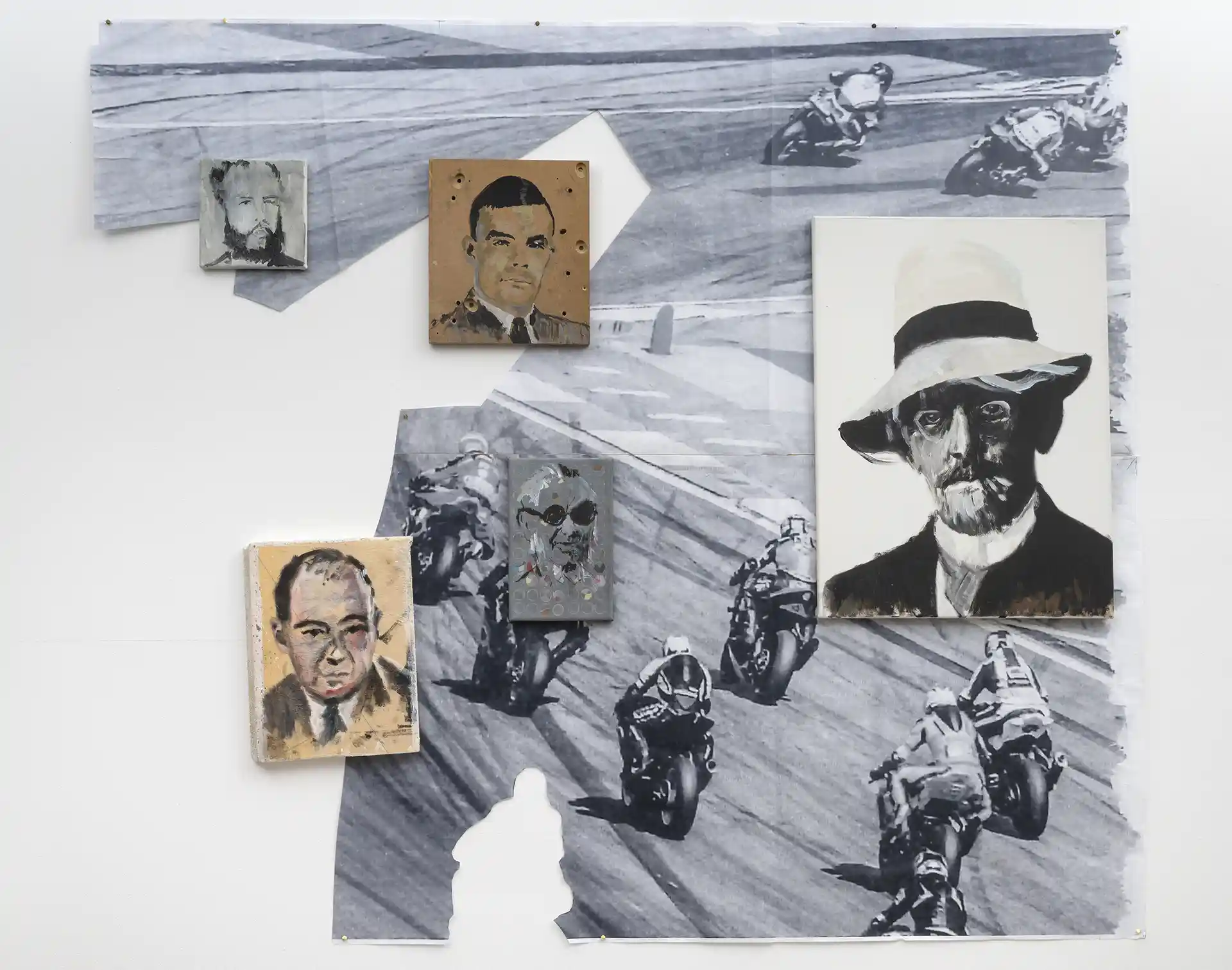
Paintings, acrylic on canvas, wood, plastic and a copy by Martin Feldbauer

5 Heroes

The mathematician David Hilbert inspired numerous colleagues to explore fundamental mathematical problems, thereby shaping research in his discipline throughout the 20th century. “Is mathematics consistent in the sense that a statement and its opposite cannot be proven at the same time?” “Is there a decision procedure that, for any statement in a given language, always provides either a finite proof of that statement or a refutation—but never both at the same time?” Questions like these led Kurt Gödel to his incompleteness theorems and prompted Alan Turing to investigate the halting problem. John von Neumann was familiar with the work of these mathematicians and knew that a universal machine must exist. He worked alongside many other prominent figures at Princeton on the creation of the computer, is considered one of the fathers of computer science, and shaped the architecture of modern computers. Without the concept of infinity, as redefined by Georg Cantor, none of this would have been conceivable.

Who will solve which problem first? Just as race bike drivers complete their laps and spur each other on to be the first to cross the finish line, the thoughts and works of these “heroes” circled around a problem until the solution became apparent.